
Hotel furniture fire standards tend to surface on handover day, when an inspector asks a question that the folder of genuine test reports in your inbox cannot answer. The reports are real. They are just about something slightly different from the chair standing in the room.
Most disputes here are not about a fake document. They are about a scope mismatch: the paper describes a material, and the question is about a finished article.
The one question behind most certificate disputes
A swatch is not an assembly
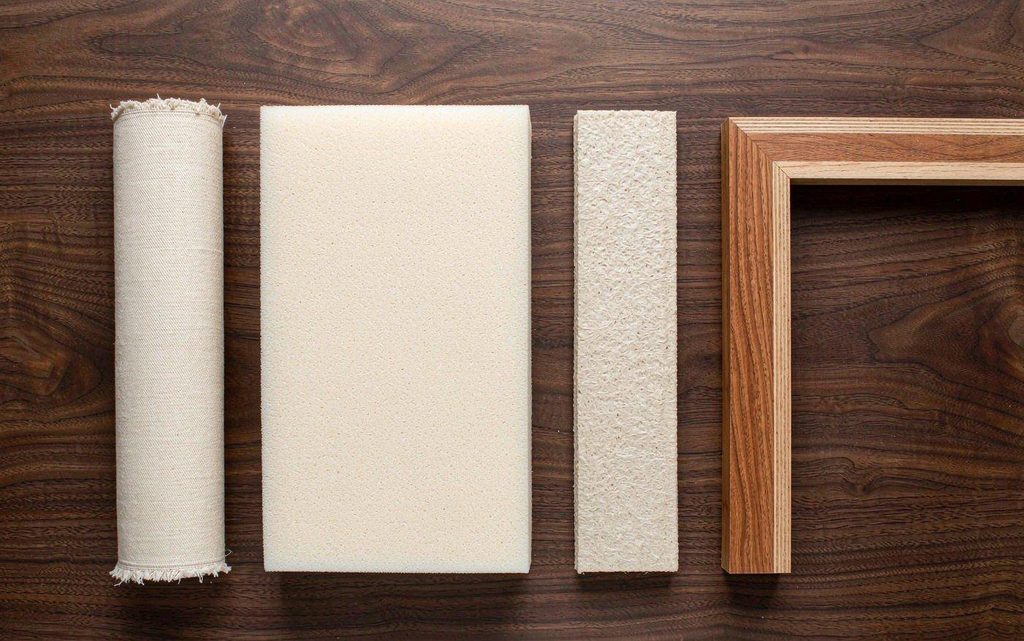
An upholstered chair is a stack of materials: face fabric, an interliner or barrier if one is used, the foam, and the frame with its adhesives and fixings. A report on the face fabric describes one layer.
Think of a tyre passing a test. That tells you something true about the tyre. It does not tell you whether the car is safe.
The layer that most often goes missing from the conversation is the second one. Whether a barrier is needed, and what it is made of, changes how the whole assembly behaves. It also changes the price and the hand of the fabric, so it belongs in the specification at the same time as the finish — not in a rush before shipment.
Four layers, one question. Illustrative image.
What the inspector is holding
At handover, the question is usually about the finished piece in front of them, in the room where it will be used, under the rules of that address. A file that lists every fabric in the collection answers a different question.
This is why two projects with the same chair can need different paperwork. The chair did not change. The address did.
Four people ask four different things
On a hotel job, the same report gets read by people looking for different things. Knowing who wants what saves a lot of back-and-forth.
| Who is asking | The question they actually mean | What usually satisfies it |
| Owner or brand team | Does this meet our brand specification? | The clause list plus the matching test evidence |
| Fire or building authority | Does the finished article meet local rules at this address? | Evidence whose scope matches the installed product |
| FF&E procurement | Can I order this without a change later? | A dated revision tying materials to finish codes |
| Factory | Which exact materials do I build with? | One locked bill of materials, no open alternatives |
Before anyone signs off, four fields on the paperwork should line up with the physical sample:
- Product or assembly description, not just a fabric name
- Material list and finish codes as they appear on the approved drawing
- Test method and edition, with the scope of what was tested
- A date, a revision and the entity that issued the report
If one of those four is vague, the folder can still be thick and still not answer the question.
The chair is what gets certified, not just its fabric. Illustrative image.
Change the address, change the question
Requirements follow where the furniture is used, not where it is made. The specifications below appear regularly in hospitality submittals; they are references for reading a specification, not a ruling for any particular project.
| Destination | Specifications commonly referenced | The question worth asking first |
| United States | CAL TB 117-2013, 16 CFR Part 1640, TB 133, NFPA 701, CARB P2 / TSCA VI | Is the request about a component, a public-space article or panel emissions? |
| United Kingdom | BS 5852 Crib 5, BS 7177 | Does the contract ask for the composite or the finished article? |
| European Union | EN 1021-1, EN 1021-2 | Are there national additions on top of the two ignition sources? |
| Middle East | BS 5852 or EN 1021 via brand standards | Which standard does the brand specify, and what belongs in the import file? |
| Australia / New Zealand | Project-specified evidence and timber packaging biosecurity rules | Which evidence does the project accept, and what applies to wood packaging? |
Confirm the current edition, the exact scope and the accepted laboratory accreditation for the destination before ordering. Standards get revised, brand standards are updated, and a port can ask for a document that the design team never saw. Treat the list above as a map of the questions, not as a compliance decision.
What actually arrives by email is a stack of reports to read. Illustrative image.
Reading a report like a till receipt
You do not need to be a lab technician. You need to check that the receipt matches what is in the bag.
- Find the product description. Does it name an assembly, or a roll of fabric and a block of foam?
- Check the material list against the finish codes on the approved drawing and the physical sample board.
- Check the method and its edition. A method number without an edition is hard to compare with a current requirement.
- Check the date and revision against the production batch, not just against the order date.
The email that saves a container
One short message before production answers most of this. Put the destination, the exact product code and the approved material list in it, then ask:
- Which finished article does the evidence need to cover?
- Is a barrier or interliner part of the approved build?
- Which method and edition does the project accept?
- Are import or biosecurity documents required for the packaging?
- Who confirms the evidence is acceptable at the destination, and by when?
Keep the reply with the drawing set. It is the cheapest insurance on the whole order.
Change one material and you start again
A substitution looks harmless on a spreadsheet. A different foam density, a new interliner, a fabric from another mill, a change of adhesive — any of these can put the assembly outside the scope of the evidence already in the file.
- Treat a material change as a new specification question, not a purchase-order edit
- Re-check the finish code, the sample board and the drawing revision together
- Do not let a substitute appear only in the packing list
- Ask for the same four fields again, dated to the new batch
Our custom design process keeps the material list and the drawing revision in one place for exactly this reason. It also makes the guest room package, the lobby seating, the meeting room chairs and the restaurant and bar pieces comparable when they arrive at the same port.
Questions that arrive on inspection day
Is a fabric-only report ever enough?
Sometimes a brand specification asks for a component test, and the fabric report is exactly what it wants. The problem is when that report is later used to answer a question about the finished chair. Ask which one the project needs before production, not at handover.
Do we need a different report for every room in the hotel?
Usually the question is about the assembly, not the room. But public spaces, mattresses, drapery and upholstered seating are commonly treated as separate items in a specification. Group the products by what is being asked, then match the evidence to each group.
Can the factory issue the certificate?
A manufacturer supplies the evidence and the material list; the report itself is issued by whoever performed the test. What you can ask the factory for is a complete, dated set that matches the exact build, with no unresolved substitutions.
What if the standard changed after we ordered?
Go back to the destination requirement rather than the original quote. Confirm which edition the project accepts, then check whether the evidence in hand still matches the material list and the production batch. A change of edition is a paperwork question until it changes the build; then it becomes a production question.
Send the destination, product codes and approved material list through the quote page or talk to the project desk, and the submittal can be prepared against the right question from the start. More plain-language guides are on the blog; the factory page shows how a locked material list reaches the line, and the project cases show a range of room types in one place.