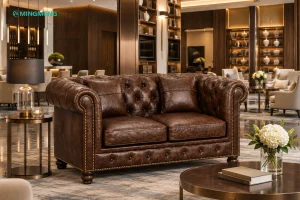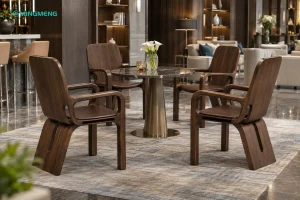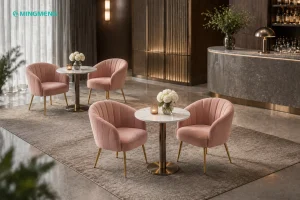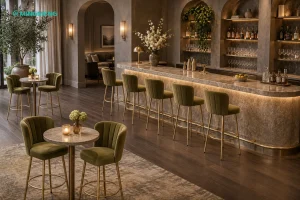
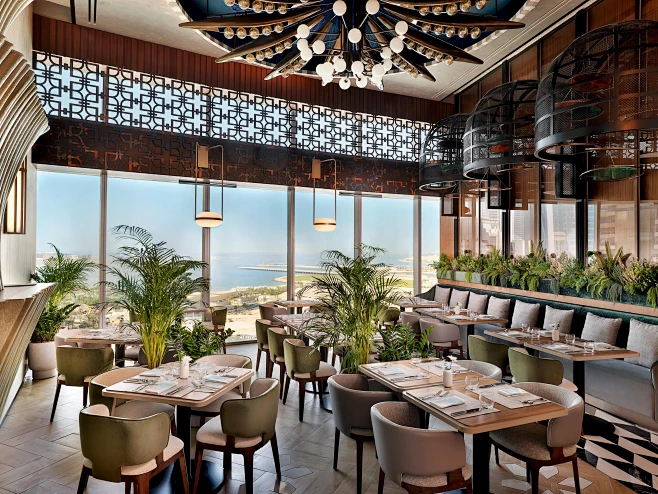
If your hotel restaurant furniture project is located in Southeast Asia, the Middle East, South America, or coastal southern China, you have likely noticed a frustrating pattern: the same quality hotel dining chairs and tables last 8–10 years in temperate climates, yet in humid environments start showing blisters, peeling edges, swollen panels, and corroded hardware within just 3–5 years. The problem isn’t humidity itself—it’s the lack of climate-specific material specifications during procurement. As a manufacturer specializing in hotel dining furniture and contract restaurant seating, we break down five material details that 80% of buyers overlook.
Spec 1: Substrate Moisture Resistance — E1 Is the Floor, Not the Ceiling
Most buyers only check formaldehyde emission levels (E1/E0) when inspecting hotel banquet furniture and dining tables, while overlooking the equally critical water absorption thickness swelling rate. Standard particle board can swell 15%–25% after 24 hours of water immersion. In humid climates where ambient humidity stays at 70%–90% year-round, panels absorb moisture slowly even without direct water contact, causing hotel dining table tops to bulge, chair side panels to warp, and cabinet doors to fail. The hidden danger: swollen substrates pull on the paint film, creating micro-cracks invisible to the naked eye. Six months later, paint blistering originates from exactly these cracks.
How to Get It Right:
- Require Moisture-Resistant Particle Board (MR-PB) or Marine-Grade Plywood (BS 1088), 24-hour swelling rate ≤ 8%
- For dining tables, buffet stations, and high-moisture zones, prioritize plywood over particle board
- Demand moisture-resistance test reports, not just formaldehyde certificates
Spec 2: Coating Systems — 1K Lacquer Is a Ticking Time Bomb in Humid Climates
Paint blistering is the most common post-installation complaint for hotel restaurant chairs and tables in tropical regions. The root cause: trapped moisture turns to vapor under heat, and when film adhesion is insufficient, the vapor pressure pushes the coating upward into blisters. Many factories cut costs by applying 1K nitrocellulose lacquer (NC) or standard PU on hotel dining chairs and table tops. These films have poor density and low cross-link density, making them prone to softening, blushing, adhesion loss, and severely reduced abrasion resistance. The stakes are even higher for restaurant furniture than guest room pieces: daily exposure to hot plates, beverages, and cleaning chemicals means once the coating fails, repair costs multiply.
How to Get It Right:
- Topcoats must be 2K polyurethane (2K PU) or acid-curing (AC) for humid-climate hotel dining furniture
- Film hardness ≥ 2H, adhesion rated ASTM D3359 4B–5B
- Primer and topcoat must be from the same compatible system to prevent inter-coat delamination
- Require a 48-hour constant temperature/humidity test (40°C / 95% RH) with zero blistering
Spec 3: Edge Banding — The Adhesive, Not the Banding, Is the Weak Link
Edge banding peeling may look minor, but it is the first line of defense collapse for hotel dining room furniture. Once the seal fails, moisture penetrates directly into the panel cross-section, causing swelling, mold, and accelerated formaldehyde release. Buyers fall into two traps: assuming thicker PVC banding is safer—yet PVC itself is waterproof while EVA hot-melt adhesive degrades in heat and humidity, and thicker banding experiences greater thermal stress; and believing solid wood edges are more premium—yet solid wood absorbs moisture, swells, and cracks in humid climates, with differential shrinkage causing lifting. For custom hotel dining furniture, peeling edges don’t just look bad—they trap food residue and bacteria during daily cleaning.
How to Get It Right:
- Prioritize 3mm PVC edge banding with PUR hot-melt adhesive (PUR outperforms EVA in heat and humidity)
- Chamfer all exposed edges (tabletop edges, chair leg fronts) to reduce moisture pooling
- Require peel-strength test reports ≥ 2.0 N/mm
Spec 4: Hardware Corrosion — The Invisible Killer Most Buyers Ignore
When procuring hotel bar furniture and dining sets, 90% of attention goes to visible panels and finishes while hardware is treated as a standard accessory. Yet in humid climates, ordinary cold-rolled steel hinges, slides, and screws show surface corrosion, stiffness, increased resistance, and loosening within 6–12 months. For hotel bar stools and folding banquet tables, hardware corrosion directly threatens structural safety—a corroded chair leg breaking under load is far more serious than a guest room nightstand hinge rusting. These “small issues” also trigger “dated facilities” reviews on OTAs, directly impacting RevPAR.
How to Get It Right:
- Hinges, slides, and connectors must be 304 stainless steel or pass 96-hour salt-spray testing
- Use stainless steel socket-head screws, not ordinary galvanized self-tapping screws
- Require suppliers to specify hardware brands (Hettich, Blum, DTC) and material specs in contract appendices
- For bathroom bar areas and outdoor terrace seating, consider 316 stainless steel or additional anti-corrosion coatings
Spec 5: Upholstery Permeability — High Density Does Not Equal Durability
Hotel dining seating and bar stools in humid climates commonly suffer foam collapse (as moisture destroys cell structures) and fabric backing mold (as trapped moisture cannot escape). Buyers usually focus only on foam density (e.g., “45D high-density foam”) while overlooking water vapor permeability. High-density foam that isn’t breathable traps body moisture and ambient humidity between fabric and foam, creating a mold incubator. For hotel banquet chairs, where dozens of guests rotate through seating during a single event, permeability directly determines both lifespan and hygiene.
How to Get It Right:
- Seat foam: density ≥ 45 kg/m³, open-cell rate ≥ 90%
- Add a 3D mesh or needle-punched non-woven layer between foam and fabric as a moisture-permeable barrier
- Prioritize natural fiber blends (cotton-linen) with good breathability; avoid PVC-coated backing fabrics
- Require compression set test reports (≤ 5%) and anti-microbial / anti-mold treatment certificates
Actionable Checklist: 7 Questions Before Ordering Hotel Restaurant Furniture for Humid Climates
| # | Question |
|---|---|
| 1 | What is the 24-hour water absorption swelling rate of your substrate? Third-party reports available? |
| 2 | Is your topcoat 1K or 2K? What are the film hardness and adhesion test standards? |
| 3 | What adhesive is used for edge banding—EVA or PUR? What is the peel strength? |
| 4 | What is the hardware material? Has it passed salt-spray testing? Duration and standard? |
| 5 | What is the foam open-cell rate? Has it been treated with anti-microbial and anti-mold agents? |
| 6 | Do you have successful hotel restaurant furniture references in humid-climate regions? |
| 7 | Does the warranty cover material defects caused by humid climates? When does the period begin? |
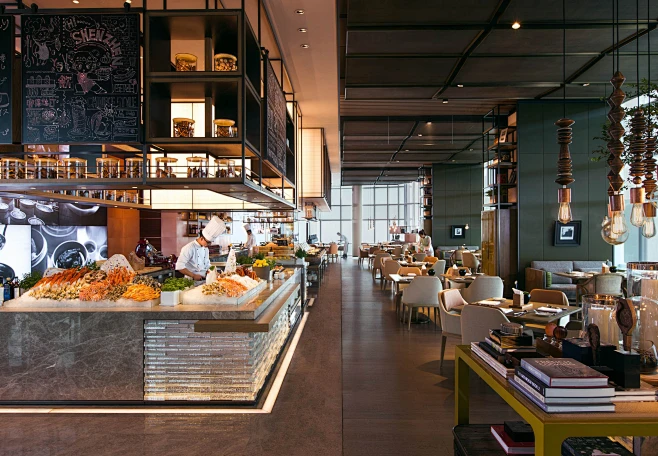
Humidity Isn’t the Enemy — Specification Mismatch Is
Ninety percent of premature failures in hotel dining furniture aren’t caused by bad weather; they are caused by applying temperate-climate material specs to tropical projects. With targeted upgrades across substrate, coating, edge banding, hardware, and upholstery, hotel restaurant chairs and tables can reliably last 8–10 years even in humid environments.
At MingMeng, every humid-climate hotel dining project receives a dedicated climate-adapted material specification. From raw material incoming inspection to pre-shipment constant temperature and humidity simulation testing, we ensure every batch of hotel furniture withstands long-term local environmental stress.
Get Your Project-Specific Material Specification — Tell us your hotel location, restaurant seating count, and design style. Our engineering team will deliver a custom proposal with full material recommendations within 24 hours.