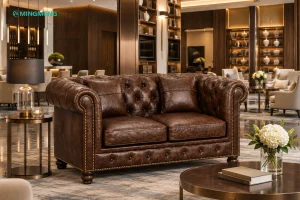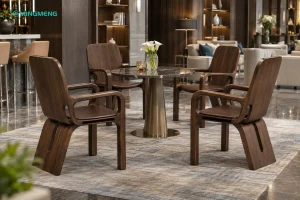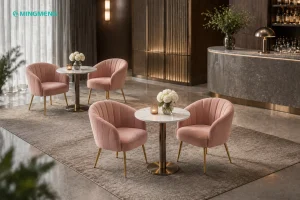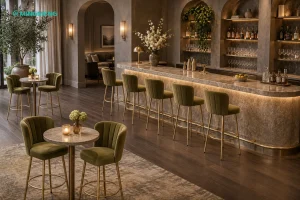
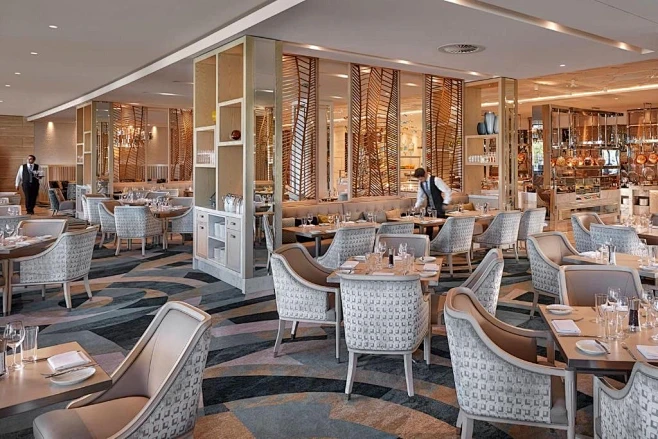
Why Does Hotel Restaurant Furniture Always Feel “Almost Right” When Copied From Restaurants?
Many hotels approach restaurant furniture procurement using the same logic as independent commercial restaurants:
- “This chair looks great — that trendy restaurant uses it too.”
- “This tabletop is durable — fast-food chains have used it for 5 years without issues.”
- “This supplier serves lots of restaurants, and their pricing is competitive.”
Six months after opening, the problems start surfacing:
- Chairs are too firm — business guests complain they’re “not suitable for extended meetings”
- Tabletops aren’t heat-resistant — hot plates from the breakfast buffet leave permanent marks
- Fire safety labels are incomplete — the hotel group’s pre-opening inspection is failed
- The supplier can’t handle bulk capacity — delivery is delayed by 3 months
- Warranty is only 1 year — hotel furniture typically requires 3+ years of coverage
Hotel restaurant furniture and commercial restaurant furniture may look identical, but they belong to entirely different product categories. Using the wrong procurement logic leads to compromised guest experiences, delayed openings, and hidden cost overruns.
This article breaks down the 7 fundamental differences between these two categories and gives you a proper procurement framework for hotel dining spaces.
Part 1: Brand Consistency — Hotel Restaurants Are Part of a “Brand System”
The Commercial Restaurant Mindset
Independent restaurants can be highly individualistic — industrial, retro, wabi-sabi, whatever the owner prefers. Even if it looks completely different from the restaurant next door, that’s perfectly fine.
The Hotel Restaurant Mindset
A hotel restaurant is part of the hotel’s overall brand experience. A Marriott restaurant needs to feel “Marriott.” A Hilton restaurant needs to feel “Hilton.” This isn’t aesthetic preference — it’s a hard requirement under group Brand Standards.
Key Differences:
| Dimension | Commercial Restaurant | Hotel Restaurant |
| Design Freedom | High — entirely owner-driven | Low — must comply with group brand standards |
| Color Schemes | Unlimited | Must align with hotel VI system |
| Material Specifications | Owner’s choice | Group may have approved supplier or material whitelist |
| Customization Level | Moderate | High — often must match guest room furniture style |
| Approval Process | Owner/designer decides | Requires group design team or brand approval |
Practical Advice: The first step in hotel restaurant furniture procurement isn’t selecting styles — it’s obtaining the hotel group’s FF&E Brand Standard document to understand the hard boundaries on style, material, and color.
Part 2: Usage Scenarios — Hotel Restaurants Have “24-Hour Versatility”
The Commercial Restaurant Reality
An Italian restaurant operates 11:00 AM – 10:00 PM. The furniture has one fixed purpose: guests arrive, sit down, eat, leave.
The Hotel Restaurant Reality
Hotel restaurants are typically multi-functional spaces:
| Time Slot | Function | Furniture Requirements |
| 6:00–10:00 AM | Breakfast Buffet | Heat-resistant tabletops, easy-clean chairs |
| 10:00 AM–12:00 PM | Coffee / Light Meals | Small tables / high tops, laptop-friendly |
| 12:00–2:00 PM | Business Lunch | Comfortable seating (1.5+ hours without fatigue) |
| 2:00–6:00 PM | Afternoon Tea / Meetings | Lounge seating, combinable large tables |
| 6:00–10:00 PM | Dinner / Banquet | Formal dining chairs, tablecloth-compatible shapes |
Core Difference: Hotel restaurant furniture must support 5+ different usage scenarios in a single day, while commercial restaurant furniture typically serves only 1–2.
Practical Advice: Hotel restaurant furniture selection must include a “time-slot scenario test” — simulating all-day usage patterns to validate functional suitability.
Part 3: Durability Standards — Hotel Restaurants Carry a “Hidden Heavy Load”
At first glance, usage frequency seems similar. In reality, hotel restaurant furniture endures significantly higher stress:
| Durability Dimension | Commercial Restaurant | Hotel Restaurant |
| Daily Operating Hours | 8–10 hours | 14–18 hours (includes breakfast) |
| Daily Table Turns | 2–3 cycles | 3–5 cycles (breakfast turns faster) |
| Guest Profile | Primarily local consumers | Business, families, conference groups — more diverse needs |
| Cleaning Frequency | Once daily (after service) | 3–5 times daily (between meal periods) |
| Cleaning Agent Strength | Standard cleaners | Hotel-grade disinfectants (more corrosive) |
By the Numbers: A hotel restaurant chair experiences approximately 1.5–2× the annual usage intensity of a commercial restaurant chair.
What this means: Furniture rated for commercial restaurants will last 30%–50% shorter in hotel restaurant environments.
Practical Advice: Hotel restaurant furniture durability standards must be upgraded one tier. For example, where commercial restaurants use “high-density foam (35D),” hotel restaurants should specify “ultra-high-density foam (45D+).”
Part 4: Fire Safety & Compliance — Hotels Are “Compliance-Intensive” Environments
This is the most critical difference between hotel and commercial restaurant furniture.
Commercial Restaurants
- Standard restaurants: Generally need only basic fire safety compliance
- Requirements are relatively loose with significant local variation
Hotel Restaurants
- International hotel groups: Must pass CAL 117 (US), BS 5852 (UK), EN 1021 (EU), or equivalent fire tests
- Domestic upscale hotels: Must comply with GB 8624 fire classification
- Some groups also require Greenguard Gold low-emission certification
Real Case: A hotel purchased commercial restaurant chairs for its all-day dining restaurant. During pre-opening inspection, the fabric was found non-compliant with CAL 117. The entire batch was returned for rework, delaying opening by 3 weeks at a cost exceeding $30,000.
Practical Advice: Hotel restaurant furniture procurement contracts must explicitly list all required certifications and require suppliers to provide original test reports (not copies).
Part 5: Supply Chain Model — Hotels Need “Project-Based” Not “Product-Based”
Commercial Restaurants
- Procurement: Item-by-item — chairs from Factory A, tables from Factory B, sofas from Factory C
- Delivery: Staggered arrivals are acceptable; timing is flexible
- Customization: Low — mostly selecting existing models with color changes
Hotel Restaurants
- Procurement: “Space package” approach — one all-day dining restaurant’s full furniture set coordinated by 1–2 core suppliers
- Delivery: Must align with construction progress and opening date — delays risk liquidated damages
- Customization: High — often requires design development, sampling, revisions, and approvals with the hotel designer
| Supply Chain Dimension | Commercial Restaurant | Hotel Restaurant |
| Number of Suppliers | Many (3–5) | Few (1–2 core + secondary) |
| Delivery Timeline Tolerance | High | Extremely low |
| Project Management Requirement | Low | High (on-site coordination needed) |
| Sample Approval Process | Simple | Complex (sample → revision → re-approval) |
| Warranty Period | 1 year common | 3–5 years standard |
Practical Advice: Don’t “piece together” multiple suppliers for hotel restaurant furniture. Choose an integrated supplier with hotel project experience who can manage design, production, delivery, and installation end-to-end.
Part 6: Warranty & After-Sales — Hotels Can’t “Just Buy a Replacement”
When a commercial restaurant chair breaks, the owner can run to a local furniture market for an emergency replacement. Hotels can’t do this because:
- Broken chairs must match existing models exactly, or space uniformity is compromised
- Marriott, Hilton, and other groups conduct annual audits on “room/restaurant furniture consistency”
- Emergency replacements require procurement approval, taking 1 week to 1 month
| After-Sales Dimension | Commercial Restaurant | Hotel Restaurant |
| Expected Warranty | 1 year | 3–5 years |
| Spare Parts Supply | Not critical | Essential (same parts available 3–5 years after production ends) |
| Response Speed | Several days acceptable | 24–48 hours (affects operations) |
| On-Site Repair | Rarely needed | Common (supplier must provide on-site service) |
Practical Advice: Hotel restaurant furniture contracts must include spare parts supply clauses (commitment to post-discontinuation alternatives) and on-site repair response clauses .
Part 7: Cost Structure — The “Hidden Premium” of Hotel Restaurant Furniture
The same chair typically costs 20%–40% more for hotel restaurant procurement than commercial restaurant procurement. This isn’t “being overcharged” — it’s a different cost structure:
| Cost Component | Commercial Restaurant | Hotel Restaurant | Reason for Difference |
| Material Cost | Baseline | +15% | Higher fire rating, more durable fabrics |
| Certification Cost | Low | +5% | CAL 117 / BS 5852 testing required |
| Customization Cost | Low | +10% | Design development to meet brand standards |
| Project Management Cost | Low | +8% | Dedicated personnel for samples, production, delivery, installation |
| Warranty Cost | Low | +5% | 3–5 year warranty vs. 1 year |
Core Insight: The “premium” on hotel restaurant furniture isn’t profit markup — it’s the cost of compliance, durability, service, and risk management. Procuring hotel restaurant furniture at commercial restaurant prices results in “looks the same, performs differently” outcomes.
Part 8: Hotel Restaurant Furniture Procurement Checklist
Before placing an order, verify every item on this list:
Brand & Standards
- Obtained hotel group FF&E Brand Standard document
- Furniture style, color, and material comply with brand standards
- Approved by group design team or brand representative
Function & Scenarios
- Scenario-tested for “breakfast → lunch → afternoon tea → dinner → banquet” full-day usage
- Tabletop heat-resistance tested (hot plate direct contact without marking)
- Chair comfort tested for extended sitting (1.5+ hours)
Compliance & Safety
- Fabric passes required fire tests (CAL 117 / BS 5852 / EN 1021 / GB 8624)
- Complete original test reports on file
- Meets formaldehyde emission standards (E0 / E1 / CARB P2)
Supply Chain & Delivery
- Supplier has hotel project experience (request case studies)
- Delivery timeline in contract with liquidated damages clause
- Dedicated project manager assigned
After-Sales & Warranty
- Warranty period ≥ 3 years
- Spare parts supply commitment (post-discontinuation alternatives)
- On-site repair response time ≤ 48 hours
Part 9: Common Mistakes — Learn From Others’ Missteps
Mistake 1: Ordering Directly From Trade Show Samples
A hotel procurement manager saw a chair at a hospitality furniture expo, liked the look and feel, and ordered 200 units. Upon arrival, the fabric didn’t meet fire safety requirements, forcing complete rework and a 2-month delay.
Lesson: Trade show samples ≠ hotel-compliant products. Verify fire certifications before ordering.
Mistake 2: Choosing a Commercial Restaurant Supplier to Save Money
A boutique hotel selected a fast-food chain furniture supplier to control costs. The chair frames used commercial-grade steel tubing (not hotel-grade reinforced frames), and batch weld cracking began at month 8.
Lesson: Commercial restaurant furniture durability standards fall below hotel requirements. Savings upfront double in after-sales costs.
Mistake 3: Ignoring Breakfast Service Requirements
A hotel all-day dining restaurant selected beautiful solid wood tabletops without considering buffet breakfast hot plates. After 3 months, the tops were covered in heat marks, requiring tablecloths that compromised the original design intent.
Lesson: Hotel restaurant furniture must pass “full-day scenario testing” — not just dinner service considerations.
Hotel Restaurant Furniture Is a Separate “Procurement Language”
The difference between hotel restaurant furniture and commercial restaurant furniture isn’t “better or worse” — it’s designed for fundamentally different usage scenarios and compliance environments.
One sentence summary:
Commercial restaurant furniture optimizes for “looks good + durable + affordable.” Hotel restaurant furniture optimizes for “compliant + consistent + sustainable.”
If you’re planning furniture procurement for a hotel dining space, remember three principles:
- Get the standards first, then select styles — Brand standards and fire certifications are non-negotiable hard requirements
- Test by scenario, not by aesthetics — Simulate all-day usage patterns from breakfast through banquet
- Choose hotel-grade suppliers, not restaurant-grade suppliers — Project experience, delivery capability, and after-sales systems matter 10× more than price
Mingmeng specializes in custom hotel furniture for domestic and international upscale hotel projects. We are familiar with FF&E standards for Marriott, Hilton, InterContinental, and other major groups, providing end-to-end services from design development, sample approval to bulk delivery. If you’re planning furniture solutions for a hotel dining space, contact our project team for procurement advice tailored specifically to hotel environments.