Blog Hotel Furniture Procurement Guide: How to Choose the Right Supplier for Hospitality Projects
Hotel Furniture Procurement Guide: How to Choose the Right Supplier for Hospitality Projects
Published on
Hotel furniture procurement is not purchasing. It is a risk-managed capital deployment across multiple product categories, lead times, and regulatory environments — and most hoteliers discover the difference the hard way.
The average mid-market hotel renovation budget runs USD 3,000–6,000 per key (per room) for select-service properties, rising to USD 6,000–12,000 for upscale tier. At 100 rooms, that’s USD 300,000–1.2 million riding on decisions made before the first purchase order is issued. The most expensive errors in hospitality furniture procurement are not made on the factory floor — they are made in the specification phase, before a single piece is quoted.
This guide covers the full procurement decision cycle: how to define specifications, qualify suppliers, manage samples, navigate FF&E logistics, and avoid the mistakes that turn capital projects into cost overruns.
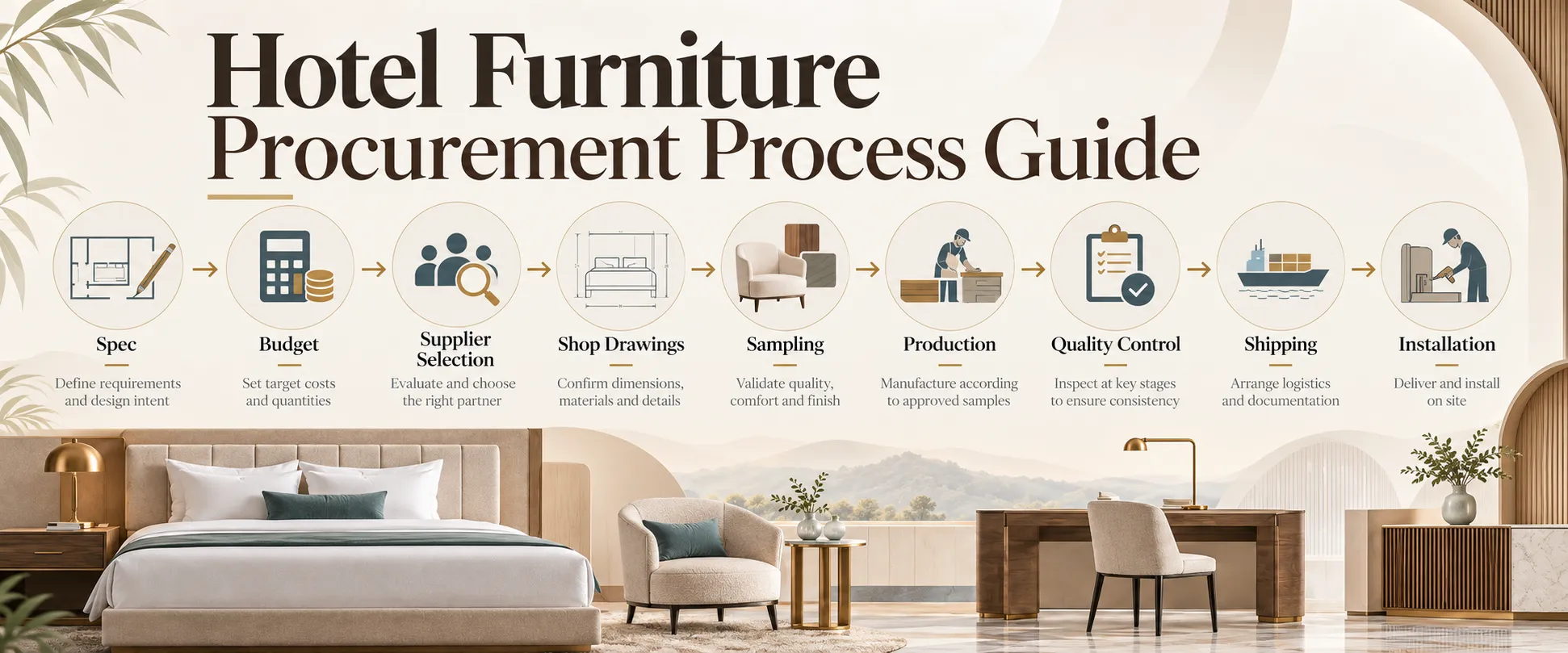
A complete hotel furniture procurement workflow showing the key stages from planning and supplier selection to delivery and installation.
Why Hotel Furniture Procurement Is Different from Restaurant Furniture Purchasing
Hotel furniture operates under constraints that commercial restaurant furniture does not face:
Multi-category coordination: Guest room, lobby, restaurant, bar, meeting room, and outdoor area each require different furniture types, lead times, and specifications — all needing to arrive within a single installation window.
Brand standard compliance: Every major brand (Marriott, Hilton, IHG, Hyatt, Wyndham) has published FF&E (Furniture, Fixtures & Equipment) standards that suppliers must meet. Non-compliant furniture can delay hotel opening and void brand licensing.
Longer replacement cycles: A hotel chair may need to last 10–15 years in a room that sees 1,000+ different guests annually. Consumer/residential-grade furniture fails this cycle count in under 3 years.
Regulatory environment: Fire code (CAL-117, CRIB-5, BS 7177), ADA accessibility requirements, and regional building codes all apply to hospitality furniture in ways they do not to restaurant seating.
Consolidated logistics: All furniture must arrive, be stored, and be installed within a defined window — often while other trades are still on site. A delayed shipment can cost USD 5,000–15,000 per day in delayed opening revenue.
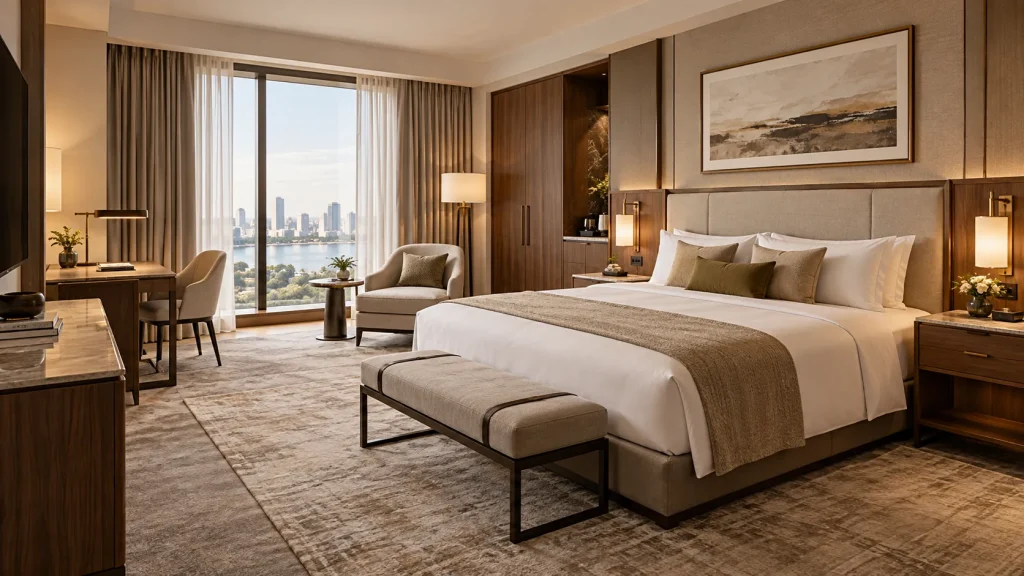
A modern hotel guest room featuring custom upholstered furniture, bedside tables, lounge seating and premium wood finishes.
The common mistake is treating hotel furniture procurement as an extended restaurant furniture order. It is not. The planning horizon, compliance requirements, and coordination complexity are fundamentally different.
Section 1: The Five Procurement Decision Points
Every hotel furniture procurement project runs through five decisions that determine success or failure:
Decision 1 — Volume and Timeline
Before anything else: define the full scope.
Number of keys (rooms) and the room type mix (standard, deluxe, suite, penthouse)
Public area square footage (lobby, restaurant, bar, meeting room, gym, outdoor)
Opening date — work backward to set production and shipping deadlines
Budget per category — guest room furniture, public area furniture, loose FF&E, and soft goods are typically budgeted separately.
A mid-market 120-key hotel with 3 public areas needs a minimum 6-month procurement window from specification sign-off to installation. Budget 8–12 weeks for sample approval, 8–14 weeks for production, and 4–6 weeks for shipping and logistics.
Decision 2 — Specification Quality
The specification document — often called the FF&E schedule — is the most important procurement tool. A weak spec produces weak quotes and weak products.
A hotel furniture specification must include:
Field
What to include
Why it matters
Dimensions
Exact W × D × H per item, in inches
Prevents arrival of pieces that don’t fit corridors or elevator thresholds
Material and finish
Wood species, metal gauge, upholstery type, surface treatment
Defines quality and ensures consistency across all pieces
Filters out suppliers unwilling to stand behind their product
A specification without dimension tolerances, performance standards, and brand references is not a specification.
Decision 3 — Supplier Qualification
Not every furniture manufacturer can execute a hotel project. Qualify on:
Production capacity: Can they produce your full order within your timeline? Ask for their current production lead time and maximum monthly output. A supplier quoting 4 weeks for a 200-key order they typically fulfill at 20 keys per month is a red flag.
Sample capability: Hotel furniture projects require pre-production samples for approval. Suppliers who cannot produce samples before bulk production cannot be trusted to hit specification in bulk.
Communication structure: Who is your point of contact? Is there a dedicated project manager or do you rotate through sales reps? Hotel projects with phased timelines need a single accountable contact who can coordinate between production and shipping.
Export experience: Has the supplier shipped to your destination country before? Customs delays on incomplete documentation can cost more than the furniture.
Certifications on file: BIFMA compliance documentation, CAL-117 test reports, CRIB-5 fire ratings, ISO 9001 production certification — ask for these before quoting.
Decision 4 — Sample Approval and Revision
The sample phase is where the spec becomes real. Budget 8–12 weeks for:
Initial sample submission — 1–3 pieces per product category for dimension, material, and finish verification
Revision cycle — any gaps between sample and spec are corrected before bulk production
Approved sample retention — the approved sample becomes the production reference standard; bulk pieces must match
Pro tip: Use the approved sample to train your on-site installation team. Furniture that “looked right in the sample” but arrives wrong usually means the sample was approved against a different spec than the one sent to production.
Decision 5 — Logistics and Installation
Hotel furniture logistics are not simple freight:
LTL vs. FCL: Less-than-container-load (LTL) shipping is common for smaller orders but adds handling risk. Full-container-load (FCL) is more cost-effective for orders above 50 cubic meters.
Delivery scheduling: Hotel sites are active construction environments. Coordinate delivery windows with the general contractor and reserve staging area before furniture arrives.
Installation oversight: Assign a site manager to receive and inspect furniture on arrival. Damage in transit must be documented within 24 hours for freight claims.
Storage: If the installation window is short, arrange secure on-site or off-site storage for the delivery window.
Section 2: The Supplier Qualification Checklist
Before requesting a formal quote, run suppliers through this checklist:
Can produce pre-production samples within 4–6 weeks of spec confirmation?
Has executed a hotel or hospitality project of comparable size in the past 3 years?
Holds BIFMA compliance documentation (X5.1, M7.1) for seating products?
Offers CAL-117 fire code compliance as standard; CRIB-5 as available option?
Provides ISO 9001 or equivalent quality management system certificate?
Has dedicated project manager assigned to hotel/hospitality accounts?
Ships to your destination country with documented customs experience?
Offers minimum 3-year structural warranty on all products?
Can provide 2–3 project references with direct contact information?
A supplier who cannot answer any of these affirmatively before the quote stage will not answer them better after the order is placed.
Section 3: How to Read and Compare Quotes
Hotel furniture quotes require comparison on more than unit price:
Total cost of ownership factors:
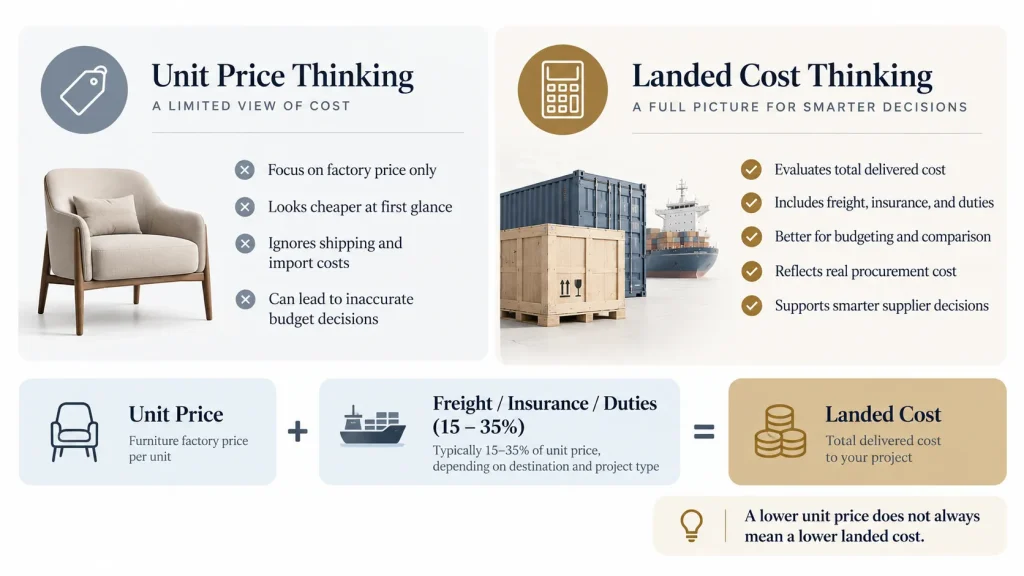
Unit price vs. landed cost: Freight, insurance, customs duties, and local delivery can add 15–35% to the unit price. Compare landed cost across suppliers.
Replacement cost: If a chair fails in year 2 at USD 150 per replacement + USD 80 labor, multiplied by 200 chairs, the cheap unit price becomes expensive quickly.
Warranty value: A 5-year structural warranty is worth more than a 1-year warranty. Quantify the difference.
Sample and revision cost: Some suppliers include sample costs in the unit price; others quote them separately. Ask for the all-in sample cost upfront.
Comparison infographic explaining why total delivered cost matters more than factory unit price alone.
Quote without a detailed spec attached (implies they will interpret the spec as they choose)
Lead time significantly shorter than industry standard (implies they will substitute or delay)
No warranty or warranty conditional on “proper use” (undefined and unenforceable)
Section 4: Common Hotel Furniture Procurement Mistakes
1. Starting procurement without a complete specification. A partial spec — missing dimension tolerances, no performance standards, no brand reference — produces quotes that are not comparable and products that are not compliant. Write the spec before requesting quotes, not after.
2. Choosing on unit price alone. A guest chair at USD 85 that lasts 4 years and a guest chair at USD 145 that lasts 12 years have a cost-per-year of USD 21.25 and USD 12.08 respectively. The expensive chair is cheaper. Hotel furniture is a capital asset, not a consumable.
3. Skipping the sample phase. Ordering bulk production without a pre-production sample is the single most expensive shortcut in hotel furniture procurement. The cost of a wrong guess at bulk scale far exceeds the cost of sample approval cycles.
4. Ignoring brand FF&E standards. Marriott, Hilton, IHG, and Hyatt each publish detailed FF&E standards. Purchasing furniture that does not meet these standards can delay brand approval, require re-procurement, and — in franchise properties — jeopardize the franchise agreement.
5. Underestimating the logistics complexity. Furniture that arrives a week late can delay a hotel opening by that week. At USD 5,000–15,000 per day in lost room revenue, one week of delay can cost more than the entire furniture budget for a 100-key economy or select-service property.
6. No on-site inspection protocol. Freight damage must be documented within 24 hours of delivery. Without a documented inspection process, damage claims are denied and the cost falls on the hotel.
Section 5: The FF&E Procurement Timeline
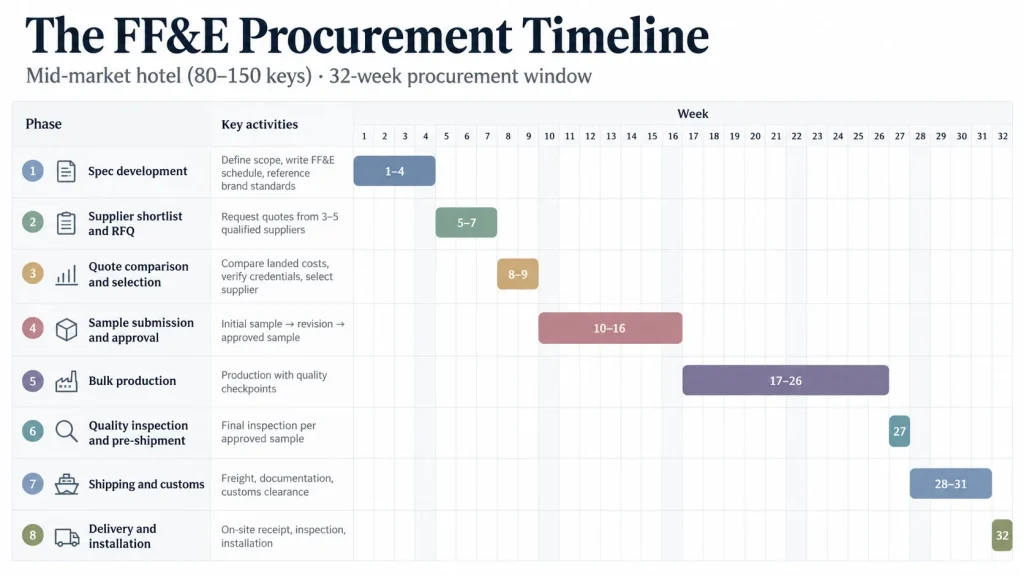
For a mid-market hotel (80–150 keys) with a 6-month procurement window:
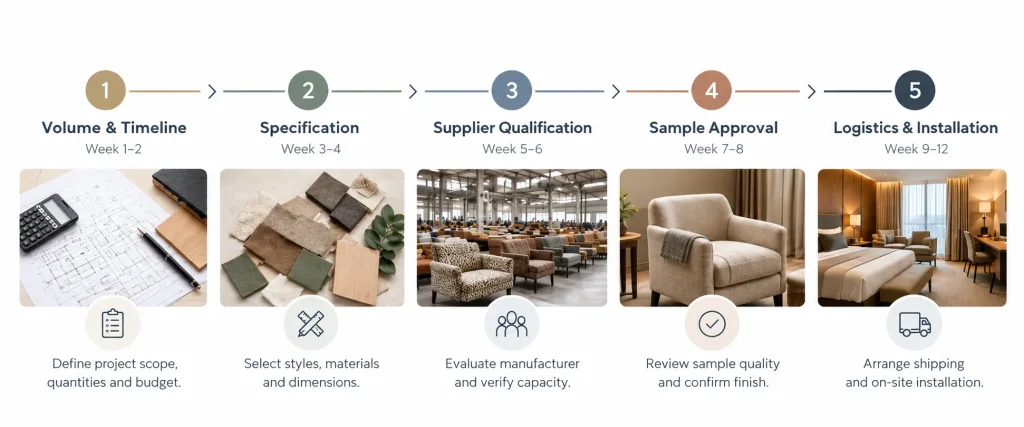
A 32-week hotel FF&E procurement schedule from specification development to delivery and installation.
Key Takeaway: The spec phase (weeks 1–4) and sample phase (weeks 10–16) are the highest-leverage periods. Errors caught in the spec phase cost hours to fix. Errors caught in production cost weeks and money.
Section 6: How MingMeng Furniture Supports Hotel Furniture Procurement
MingMeng Furniture is a Guangzhou-based hotel furniture manufacturer with production capacity for projects from 50 to 500+ keys, serving hospitality clients across the USA, Australia, Singapore, and India. Our product range covers the full hotel furniture spectrum — guest room casegoods, lobby and public area seating, restaurant and bar furniture, meeting room tables, and outdoor pool patio furniture — all built to BIFMA commercial standards and compliant with CAL-117 and CRIB-5 fire code requirements.
What we provide for hotel furniture procurement projects:
Complete FF&E scope coverage: Single-supplier accountability for guest room, public area, and specialty furniture — reducing coordination complexity across multiple vendors.
Sample-to-production consistency: Pre-production samples produced from the same production line and to the same specification as bulk orders. No sample-bulk divergence.
Brand standard compliance: Experience meeting Marriott, Hilton, and independent boutique brand FF&E standards. We review your brand manual and align specifications before quoting.
Dedicated project manager: One point of contact from spec review through installation, with regular production updates and quality checkpoints.
Commercial-grade certifications: BIFMA X5.1 seating compliance, CAL-117 fire code standard, CRIB-5 available, ISO 9001 quality management — documentation package provided with every project.
Logistics coordination: FCL and LTL shipping, customs documentation, and on-site delivery scheduling coordinated with your general contractor.
Warranty and after-sales: Minimum 3-year structural warranty on all hotel furniture; spare parts available for 5 years post-delivery.
Browse our hotel furniture project cases for completed hotel installations across guest rooms, lobbies, restaurants, and public areas.
To discuss your hotel furniture procurement requirements, reach out to our team directly. Mention this guide and we’ll respond with a project-specific qualification form within 24 hours.
Frequently Asked Questions
What is the typical timeline for hotel furniture procurement? A mid-market hotel (80–150 keys) requires a minimum 6-month procurement window from specification sign-off to installation. Budget 4–6 weeks for spec development, 6–8 weeks for sample approval, 8–14 weeks for production, and 4–6 weeks for shipping and installation. Projects above 200 keys or with custom specifications may require 8–9 months.
How do I know if a hotel furniture supplier is reliable? Run them through the qualification checklist: pre-production sample capability, BIFMA compliance documentation, dedicated project manager, export experience to your destination, and 3-year minimum warranty. Suppliers who cannot answer these before quoting will not improve after the order is placed.
What fire code compliance is required for hotel furniture? In most markets: CAL-117 (California fire code, widely adopted in the US) and/or CRIB-5 (British standard, required in many international markets). BS 7177 is also common in the UK and Commonwealth markets. Ask your supplier for test reports — not just a compliance claim — and verify these are current (within 3 years).
How much should I budget for hotel furniture per key? Budget varies by tier: economy/limited-service runs USD 1,500–3,000 per key in total FF&E; select-service/upper-midscale runs USD 3,000–6,000; upscale/lifestyle runs USD 6,000–12,000; luxury runs USD 12,000–25,000+. Guest room furniture alone (excluding soft goods, lighting, and artwork) typically represents 40–55% of that total, decreasing as a percentage at higher tiers.
Should I use one supplier for the entire hotel or split by category? Single-supplier procurement is strongly preferred for hotels under 200 keys. It reduces coordination complexity, provides one accountability point, and enables consolidated shipping. Split procurement (separate suppliers for seating, casegoods, and outdoor) is manageable above 200 keys where the volume justifies the coordination overhead.
What is FF&E in hotel procurement? FF&E stands for Furniture, Fixtures & Equipment — the moveable, non-structural items in a hotel that do not become real property. FF&E procurement covers guest room furniture, public area seating, loose tables and chairs, lighting, artwork, and soft goods. It is distinct from OS&E (Operating Supplies & Equipment) which covers items that consume or wear out annually.
Last updated: 2026-09-24. Compliance and construction standards referenced from BIFMA X5.1/M7.1, CAL-117, CRIB-5, and BS 7177. Budget figures are typical industry ranges; verify with a detailed project quotation for your property.
Explore Other Products
Get more industry insights
Looking for the right solution? Fill out the form and get a free quote.


 Español
 Français
 Deutsch
 العربية
 Português
 Русский
 日本語
日本語 한국어
한국어 Italiano
 Nederlands
 Polski
 Türkçe
 Tiếng Việt
 ไทย
ไทย Bahasa Indonesia
 简体中文
简体中文